Why Creativity, Trust, Intelligence, and Expertise Will Shape 2027
The next competitive advantage will not belong simply to those who create more. It will belong to those who can turn identity, knowledge, credibility, and human judgment into meaningful value.
BY EZRA JONES | FOUNDER & CULTURAL IDENTITY ARCHITECT(TM), THE FSTATE(TM)
OPENING | A NEW UNDERSTANDING OF VALUE
As we close out 2026 and prepare for 2027, I believe we are witnessing a consequential shift in
how economic value is created, communicated, recognized, and exchanged.
For decades, businesses have competed through access to capital, production capabilities,
distribution, institutional relationships, and information. Those advantages still matter. But
technological advancements are changing how much individuals and smaller organizations can
accomplish without owning the traditional infrastructure that once defined economic
participation.
Artificial intelligence has made certain forms of research, production, analysis, and execution
more accessible. Digital platforms have given independent creators opportunities to reach
audiences without relying exclusively on established media organizations. Specialized
professionals can commercialize knowledge through consulting, training, subscriptions, and
digital services.
At the same time, consumers and organizations must decide whom to believe, which
relationships deserve investment, and how to distinguish genuine expertise from convincing
presentation.
I see four interconnected economic forces that warrant particular attention: the Creator Economy,
the Trust Economy, the Intelligence Economy, and the Expert Economy.
These are not four mutually exclusive industries or universally standardized economic categories.
They are overlapping ways to understand how value moves through the marketplace. One turns
creative expression into commercial relationships. Another determines how credibility influences
economic decisions. The third converts information into usable intelligence. The fourth applies
specialized judgment to problems requiring more than readily available answers.
The opportunity is not simply to participate in one of these economies. It
is to understand how they reinforce one another.
THE CREATOR ECONOMY: CREATIVITY AS COMMERCIAL INFRASTRUCTURE
The creator economy is frequently reduced to influencers, sponsored posts, and social media
audiences. That definition is too narrow.
It includes independent publishers, filmmakers, designers, educators, photographers, musicians,
writers, cultural entrepreneurs, and other professionals who develop original work and establish
commercial relationships around it.
A creator is not necessarily an influencer. An audience is not necessarily a business. And visibility
is not necessarily evidence of economic sustainability.
A photographer may earn money through commissions, licensing, education, and creative
direction. A musician may generate revenue through performances, recordings, merchandise,
publishing, and partnerships. An independent publisher may develop subscriptions, events,
sponsored editorial programs, research products, or intellectual property.
These businesses may begin with an individual’s creativity, but sustaining them requires
positioning, rights management, business development, operational capacity, and trustworthy
relationships.
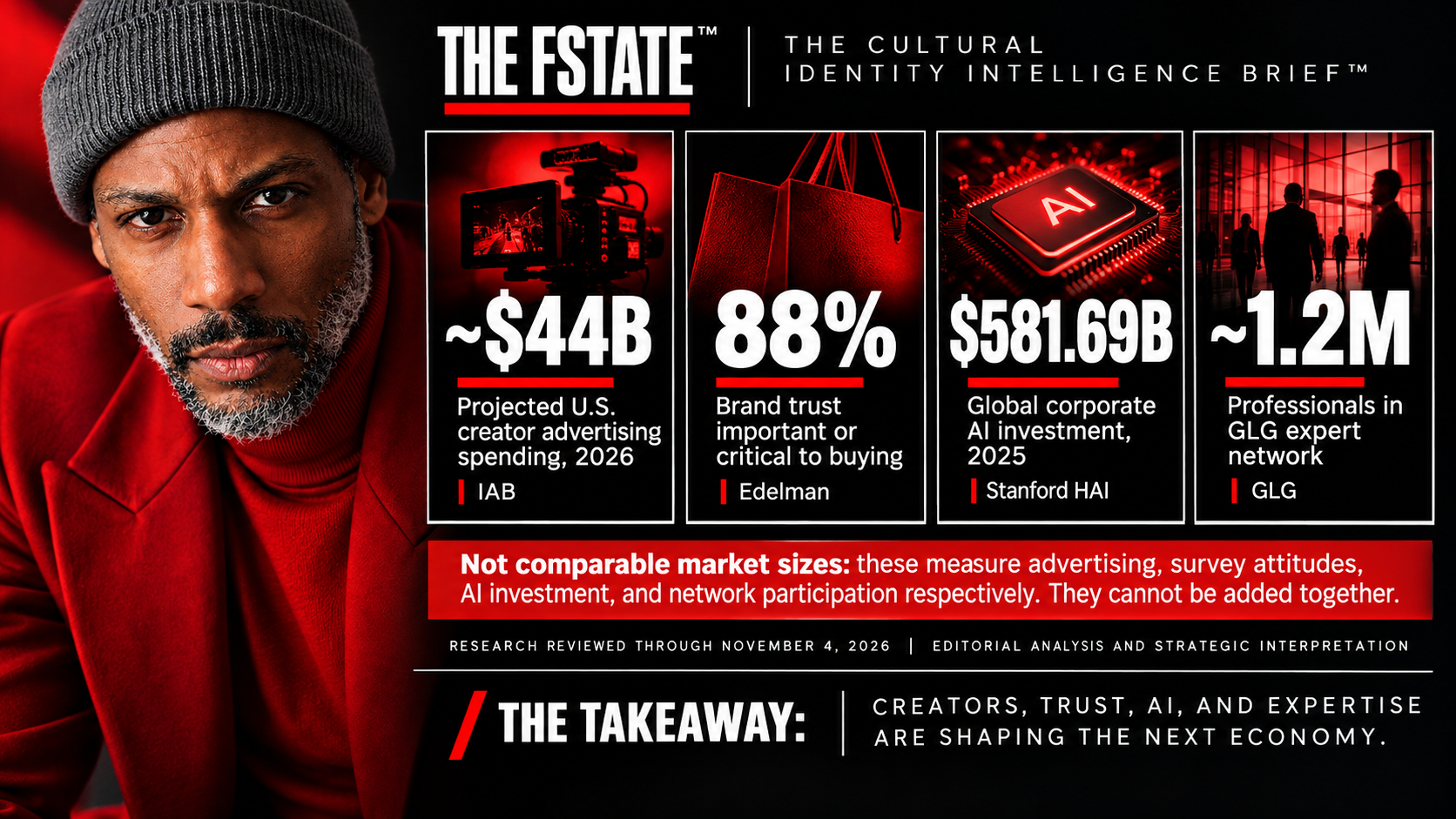
The Interactive Advertising Bureau estimated U.S. creator advertising spending at approximately
$37 billion in 2025 and projected roughly $44 billion for 2026. These figures refer to creator
advertising, not the entire creator economy. IAB’s September 2026 CreatorFronts discussion also
emphasized infrastructure challenges involving measurement, reporting, and commercial
processes.
A creator with cultural relevance may still struggle to explain commercial value to a potential
partner. They may have an engaged audience but lack a clear offer, licensing agreements, or the
operational structure to support larger engagements.
The next chapter of the creator economy will require creators to become
more than visible. They must become understandable, commercially
prepared, and capable of protecting the value they create.
THE TRUST ECONOMY: CREDIBILITY AS A COMPETITIVE ASSET
Technology has made it easier to communicate professionally. An attractive website, polished
brand identity, persuasive presentation, and extensive content can be produced without
necessarily demonstrating the capabilities those materials imply.
The appearance of credibility is not the same as being credible. Trust develops when claims are
supported by consistent behavior, verifiable evidence, and reliable experiences. Every purchase, partnership, investment, and professional relationship involves uncertainty: Will
the person deliver? Is the expertise real? Can the claims be verified? What happens when
expectations are not met?
Edelman’s 2026 brand research found that 88% of respondents considered trusting a brand
important or critical to a purchase decision, alongside quality at 89% and value at 88%. These are
stated purchasing priorities, not proof that trust independently causes sales. The same research reported 66% expressing hesitation or unwillingness to trust people who differed from them across the characteristics tested, including values, information sources, and backgrounds.
For founders working across communities, a business may possess genuine value yet remain
misunderstood. Another may be widely recognized but lose confidence when conduct contradicts
messaging.
At The Fstate, we describe one part of this challenge as the Identity–Perception Gap(TM): the
disconnect between who an organization is, how it communicates its value, and what its audience
actually understands or believes.
Closing that gap may require examining behavior, strengthening evidence, clarifying positioning,
improving the customer experience, and reconsidering relationships. Communication should
make trustworthy conduct understandable. It should never substitute for trustworthy conduct.
Attention may introduce people to a business. Trust helps determine whether they are willing to do business with it.
Yet the market may understand only one dimension of their value: a photographer rather than a
creative strategist; an influential personality rather than a viable founder; an accomplished
practitioner whose expertise is difficult to purchase.
The four economies offer different questions. Creator: What do you produce, and how does your
work attract the right people? Trust: Why should those people believe your claims? Intelligence:
How do you convert information and experience into decisions? Expert: What specific problem do
you solve?
Each question requires evidence. A compelling story without demonstrated capability may create
interest but not confidence. Credibility without an offer may produce admiration but limited
revenue. Knowledge without application may create information rather than change.
The opportunity lies in connecting these capabilities strategically.
CULTURAL IDENTITY: THE BRIDGE BETWEEN VALUE AND UNDERSTANDING
Many founder-led businesses have spent years accumulating value through relationships,
capabilities, community contribution, and experience. But public identities do not always reflect
the full significance of that work.
A founder may have evolved beyond the category where people first discovered them. Services
may have expanded while positioning remained unchanged. Knowledge may be embedded in the
founder rather than documented through repeatable methods.
The Fstate exists to help misunderstood founder-led brands become understood, trusted, and
chosen. Our strategic progression is Identity → Understanding → Trust → Authority → Opportunity.
These are not automatic outcomes. They are questions to investigate: Do we know who we are?
Can the intended audience understand our contribution? Does behavior support our claims? Is our
authority demonstrated? Are the right offers and relationships in place?
The Cultural Identity Operating System(TM) organizes these questions into an approach to
diagnosis, decisions, and development. Its value must be established through client evidence,
repeatable findings, and measurable improvements, not merely by naming a proprietary
framework.
Understanding is not engineered by making stronger claims. It develops
by bringing identity, communication, evidence, and experience into
better alignment.
WHY MORE VISIBILITY IS NOT ALWAYS THE ANSWER
More content, followers, advertising, publicity, and exposure can create value when connected to
sound strategy. But they cannot solve every underlying problem.
If a business cannot explain its offer, greater exposure can distribute confusion. If operations
cannot support growth, increased demand may reveal weaknesses. If reputation has been
damaged by poor performance, promotion cannot independently repair trust.
This does not make marketing irrelevant. It makes alignment essential. Visibility should help the
right people recognize meaningful value, not conceal uncertainty about that value.
The distinction is not who can generate the most attention, but who can
substantiate what they communicate.
WHAT FOUNDERS SHOULD PREPARE FOR IN 2027
First, take intellectual property seriously. Original work, documented methodologies, contracts,
licensing, and identifiable contributions support sustainable business models. Metadata or a
published claim does not by itself establish every legal right. Second, translate experience into offers. Identify the problem you diagnose, the decision you support, and the responsibility you accept.
Third, substantiate reputation through case studies, references, verified outcomes, and
transparent processes.
Fourth, implement AI and automation where they improve accuracy, efficiency, and accountable
decisions, not merely because the tools are available. Finally, pursue collaborations built on complementary capabilities, defined roles, sound agreements, and shared outcomes, rather than on visibility or mutual admiration alone.
Creative expression attracts interest. Evidence supports credibility. Intelligence improves choices.
Expertise solves consequential problems. Relationships extend the opportunity to apply them.
THE ADVANTAGE IS ALIGNMENT, NOT JUST ACCESS
Access remains important, and inequalities in capital, technology, education, and networks still
shape who can participate. But access alone is not a complete strategy. Two businesses can use the same AI and reach different outcomes. Two professionals can have similar credentials but different judgment. Two creators can attract comparable audiences but develop different commercial relationships.
The difference may be positioning, reputation, operating discipline, experience, market
conditions, or decisions made over time. No single factor guarantees success. Our opportunity is to recognize existing value, identify the right problem, connect complementary people, build dependable systems, communicate with clarity, and establish relationships that
endure.
THE FUTURE NEEDS BUILDERS, NOT JUST MORE OUTPUT
Entering 2027, it will not be enough to create content without understanding the business behind
it. Visibility without evidence cannot establish credibility. Technology without judgment cannot
guarantee good decisions. And expertise that buyers cannot understand may remain difficult to
commercialize.
Value must be created, understood, substantiated, and applied.
A founder’s greatest asset may not be a single product, platform, or title. It may be the distinctive
combination of experience, perspective, relationships, judgment, and intellectual property
accumulated over time. The challenge is translating that combination into something other people can understand, trust, and engage.
The future will reward innovation, but innovation without judgment can create costly errors.
Creativity without infrastructure can struggle to sustain itself. Information without interpretation
can produce confusion. Expertise without trust may never get the opportunity to prove its value.
The question for 2027 is not simply, “What can I create?” It is, “What do I understand that others
need? What can I demonstrate that others can trust? What problems am I equipped to solve? And
who can I build with to create lasting value?”
Because visibility is rented. Identity is owned. And opportunity becomes more attainable when the value behind that identity is understood. The future does not simply need more creators. It needs builders who understand how creativity, trust, intelligence, and expertise work.